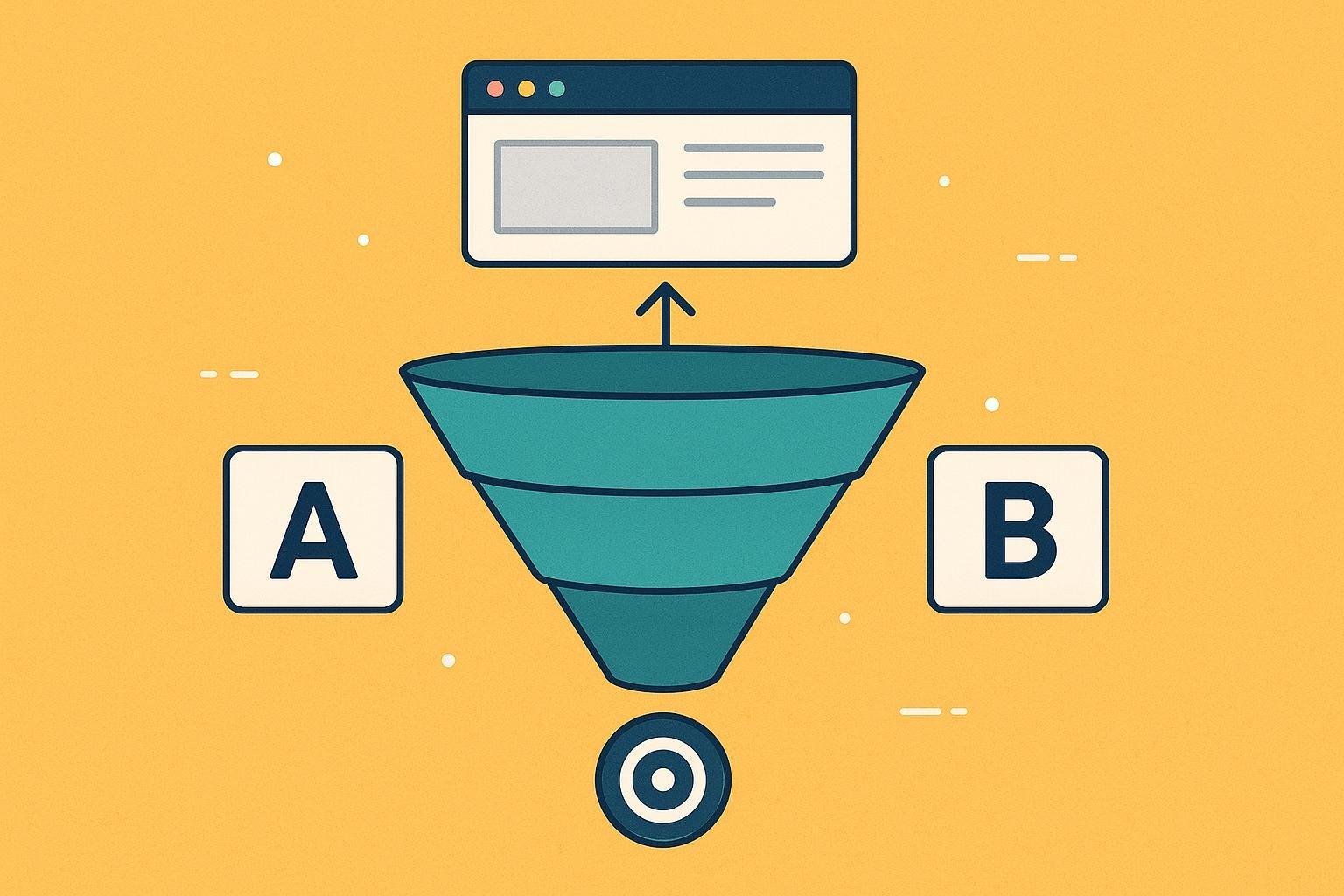
If you have a capture page to generate subscribers or leads and you feel that you are not getting the results you expected, A/B testing is an essential tool to optimize your conversions. This technique consists of comparing two versions of the same page to find out which one works better, based on real data and not on assumptions.
Implementing A/B tests on your capture pages does not require advanced technical knowledge and can provide you with significant improvements in a very short time. In this article you will learn step by step how to perform these tests and use the results obtained to efficiently increase your conversion rate.
Index
- What is A/B testing and how can it increase the conversion of your capture page?
- Key elements on your capture page that you should A/B test
- Recommended tools for effective A/B testing of capture pages
- Interpretation and analysis of results in A/B tests to optimize your landing page
- Common mistakes in A/B testing and how to avoid them to maximize results
- Frequently Asked Questions
- To conclude
What is A/B testing and how can it increase your capture page conversion?
An A/B test consists of creating and comparing two different versions of your capture page to analyze which one has better conversion performance. You can test variations in titles, texts, images, button colors or even forms, accurately measuring which one generates more subscriptions, registrations or sales.
Implementing this technique allows you to make decisions based on real data, eliminating assumptions. For example, you could experiment by changing concrete elements such as:
- Main title: Which message connects best with your audience?
- Button text: “Sign up now” or “Sign in for free”? Small adjustments can make a big difference.
- Images and videos: Do your visitors prefer visual or textual content?
With the results obtained you will be able to continuously optimize your site, significantly increasing your conversion rates and profitability.
Key elements on your capture page that you should A/B test
When it comes to optimizing your capture page through A/B testing, it’s critical to focus on those elements that have the greatest influence on conversion. Below, I highlight the key components you should test whenever you can:
- Main title: Try different messages and approaches to immediately capture the visitor’s attention.
- Registration form: Experiment with the number and type of fields requested (name, email, phone) to find the perfect balance between amount of information and conversion rate.
- Call to action (CTA): Evaluate different text, colors, sizes and button locations to determine which combination generates the greatest response.
- Images and videos: Compare the visual impact of different graphic or multimedia resources on the user’s decision.
Also, consider testing secondary but relevant elements such as customer testimonials, guarantees or trust seals. These small variations can significantly influence your visitors’ perception of credibility and security, thus increasing the likelihood that they will complete the registration.
| Element tested | Variant A | Variant B | Winning result |
|---|---|---|---|
| Main Title | Download your free guide | Get your free ebook now | Variant B (+22%) |
| CTA (button color) | Green | Orange | Variant A (+15%) |
| Form (fields) | Email + Name + Phone | Email only | Variant B (+32%) |
Recommended tools for effective A/B testing of capture pages
To get reliable results and easily optimize your capture pages, it is essential to choose tools that allow you to perform A/B tests easily and efficiently. Here are some popular and easy-to-use options:
- Google Optimize: Free and easy to integrate with Google Analytics. Ideal if you are looking for an economical and powerful solution to start with quick experiments.
- Optimizely: Advanced platform with intuitive features including audience targeting and deep analytics. Perfect if you are looking to scale your experiments.
- VWO (Visual Website Optimizer): Offers a user-friendly visual interface and numerous customization features for non-technical users.
If you are still not sure which one to choose, here is a quick comparison:
| Tool | Ease of use | Cost | Analytics Integration |
|---|---|---|---|
| Google Optimize | Sign up | Free | Yes |
| Optimizely | Medium-High | Monthly payment | Yes |
| VWO | Sign up | Monthly payment | Yes |
Remember that the choice will always depend on your budget, objectives and specific needs. The important thing is that you can easily experiment and measure your results to continuously improve the performance of your capture pages.
Interpretation and analysis of results in A/B tests to optimize your landing page
When running A/B tests, your main goal is to understand which of your versions generates the best results and, above all, why. Don’t just look at which version has more conversions; dig deeper into the key metrics that tell you about actual user behavior:
- Conversion rate: percentage of visitors who complete your form or desired action.
- Average time on page: indicates whether the content is engaging and relevant.
- Bounce rate: helps you detect if visitors quickly abandon your landing page.
- CTR (Click Through Rate): shows which visual elements and texts generate the most interaction.
Analyze the results using comparative tables to clearly visualize the differences:
| Metrics | Version A | Version B | Difference (%) |
|---|---|---|---|
| Conversion rate | 3,2% | 4,6% | +43,7% |
| Average time on page | 45 seconds | 67 seconds | +48,9% |
| Bounce rate | 65% | 51% | -21,5% |
Look at this data together to detect patterns. If version B has a higher conversion rate and also a higher average time on page, it probably means that the content is more relevant and engaging. Use this information to make informed decisions and further optimize your landing page.
Common mistakes in A/B testing and how to avoid them to maximize results
Performing A/B tests may seem simple, but some common mistakes can sabotage your results. One of the most common is to stop the test too early, based only on initial results that may change over time. To avoid this, set a sample size and a minimum duration (e.g. one week or until you reach at least 1,000 visitors).
Another common mistake is to test too many variables at once, making it difficult to identify which specific change had the greatest impact. To maximize results, make gradual, targeted changes to your capture pages, focusing on one element at a time: headlines, call-to-action buttons, images or forms. Some key elements you could test are:
- Headlines: Change the main message to measure the difference in conversions.
- Button colors and placement: Evaluate how they affect click-through and conversion.
- Images or videos: Determine which type of visual content generates more interest.
Finally, remember that incorrect metrics can lead to erroneous conclusions. Don’t just focus on clicks or visits; also measure actual conversions, cost per acquisition and profitability to make informed and effective decisions.
Frequently Asked Questions
What is A/B testing and how can it help me improve my capture page?
An A/B test is a technique that consists of creating two slightly different versions of the same page (version A and version B) to measure which one performs better in terms of conversions or lead capture. By analyzing the results, you can identify which specific elements work best with your audience and improve the effectiveness of your capture page.
What elements can I evaluate with an A/B test on my capture page?
You can evaluate different aspects such as the headline, images, colors, call-to-action (CTA) button text, forms or content distribution. By focusing on these elements, you will be able to identify which variables are most effective in capturing the attention of your visitors and increasing the conversion rate.
How long should an A/B test take to obtain reliable results?
The ideal test duration depends mainly on the volume of traffic your site receives. Normally, it is recommended that the test lasts at least one to two weeks to obtain a representative sample. It is important not to stop the test too early, as you may get unreliable or biased results.
Is it better to run several tests at once or to focus on a single item?
It is advisable to evaluate only one element at a time, especially if you are starting with A/B testing. This way, you will know exactly which change produced the improvement or worsening in your results. Once you have more experience, you can experiment with multiple variations, but always make sure that the results are clear and easy to interpret.
How do I analyze the results obtained in an A/B test?
You should compare key metrics, such as conversion rate, click-through rate or the number of leads captured. There are specific A/B testing tools that will provide you with these results and show you which version is more effective. When analyzing the data obtained, make sure that the difference is statistically significant in order to make informed decisions.
What should I do after identifying which version works best?
Once you have identified the winning version, implement those changes on your capture page. However, the process does not end there. Continue to run periodic tests to further optimize your page and keep it up to date with user preferences and behaviors, as these may change over time.
To conclude
Now that you know how to use A/B testing to optimize your capture pages, it’s time to put these tips into practice and start improving your results. Remember that the key is to constantly experiment and analyze the data obtained to make informed decisions.
Don’t worry if the changes seem small at first, as continuous optimization generates significant improvements in the long run. With patience, persistence and attention to detail, you will be able to significantly increase the conversion of visitors into leads.
Are you ready to take the next step in your digital strategy? Start implementing A/B testing today and take your capture pages to the next level – best of success!