If you are investing time and money in digital marketing, it is essential that you learn how to measure the real profitability of your actions. Knowing how to calculate ROI (Return on Investment) will allow you to identify which strategies work best and which ones you should optimize or discard.
In this article you will discover what exactly is ROI in digital marketing, how to calculate it step by step and how to interpret the results obtained. This way, you will be able to make informed decisions, reduce risks and multiply the chances of success in your online business. 
Index
- What is ROI in digital marketing and why is it key to measure it?
- Basic ROI formula and how to apply it to digital campaigns
- Essential tools and metrics to evaluate the return in digital marketing
- Common mistakes when calculating ROI in digital campaigns and how to avoid them
- Practical tips to optimize the return on investment in digital marketing
- Frequently Asked Questions
- Summary
What is ROI in digital marketing and why is it key to measure it?
ROI (Return on Investment) is one of the most important indicators in your digital marketing campaigns, as it clearly shows which strategies work and which do not. By measuring ROI correctly, you can optimize your advertising budget and allocate resources wisely to maximize your profits.
Monitoring and analyzing your ROI will help you:
- Make data-driven decisions: you will know exactly where to invest more and where to cut costs.
- Increase your profitability: quickly identify winning strategies to replicate and scale them.
- Reduce financial risks: minimize losses by abandoning ineffective tactics.
Remember that, in digital marketing, every euro invested must generate a clear positive return. If you are not accurately measuring your ROI, you will be sailing blind, wasting time and money on actions that may not bring real value to your business. 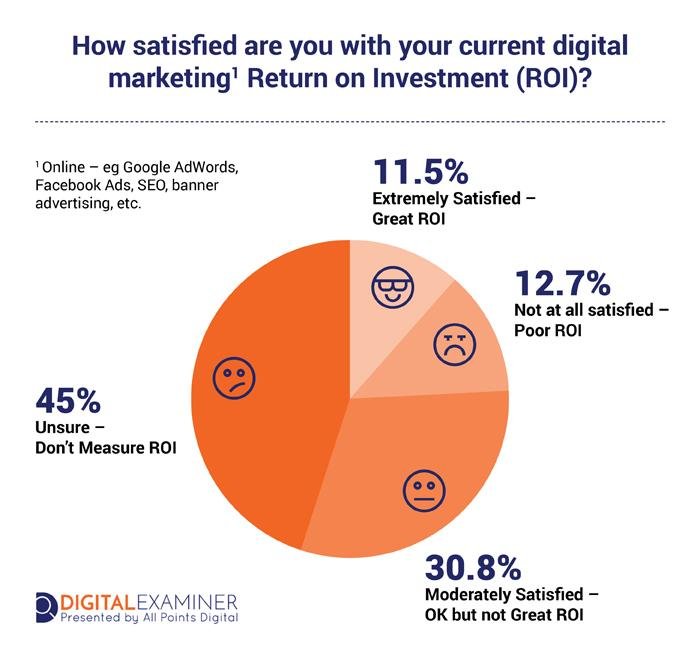
Basic ROI formula and how to apply it to digital campaigns
ROI (Return on Investment) is a key metric that measures the profitability of your digital marketing investments. The basic formula you should use is simple:
| ROI Formula |
|---|
| ROI (%) = [(Revenues – Costs) / Costs] x 100 |
To apply it to your digital campaigns, follow these steps:
- Calculate the revenue generated: add up all the sales or conversions coming directly from the campaign.
- Determine total costs: include expenses for advertising, digital tools, content creation and expert fees.
- Apply the formula: subtract costs from revenues, divide the result by costs and multiply by 100 to obtain a percentage.
For example, if you invest €500 in a Facebook Ads campaign and generate €2,000 in sales, your ROI will be 300%. This means that, for every euro invested, you have obtained 3 euros of profit.
Essential tools and metrics to evaluate the return in digital marketing
To really evaluate whether your digital marketing investment is paying off, you need to know the key tools and specific metrics that reveal your performance. Google Analytics is one of the most powerful and free, allowing you to measure traffic, conversions and user behavior. In addition, tools such as Facebook Ads Manager or HubSpot make it easy to measure the performance of specific campaigns and cost per acquisition (CPA).
Essential metrics include:
- Conversion rate: percentage of visitors who perform the desired action, such as buying or subscribing.
- Cost per acquisition (CPA): how much you invest on average to get each new customer.
- Return on advertising investment (ROAS): revenue generated for each euro invested in advertising.
Below is a practical example of how you could record these metrics for a fictitious campaign:
| Campaign | Investment (€) | Revenues (€) | Conversion Rate (%) | CPA (€) | ROAS |
|---|---|---|---|---|---|
| Online Course | 500 | 2.500 | 5% | 10 | 5 |
| Ecommerce Shoes | 1.000 | 4.500 | 3% | 15 | 4,5 |
By systematically measuring these figures, you will be able to optimize your digital strategy, reduce costs and maximize profits.
Common mistakes when calculating ROI in digital campaigns and how to avoid them
One of the most common mistakes is not including all the costs involved in the campaign. For example, you may be considering only direct ad spend, forgetting indirect costs such as digital tools, affiliate commissions or content creation. To avoid this mistake, make a complete list that includes:
- Direct costs: advertising on Google Ads, Facebook Ads, influencers, etc.
- Indirect costs: subscriptions to tools (email marketing, web analytics), content creation, graphic design, commissions, etc.
Another common mistake is to measure ROI too early, before campaigns have reached their peak performance. Some digital strategies, such as SEO or content marketing, require time to show tangible results. To get a more accurate picture, set specific analysis periods for each type of campaign:
| Campaign Type | Ideal period to measure ROI |
|---|---|
| PPC advertising (Google, Facebook) | 1-2 weeks from activation |
| Email marketing | 2-4 weeks after sending |
| SEO and Content Marketing | 3-6 months from implementation |
Finally, another common mistake is not clearly defining the objectives before starting the measurement. If you don’t know exactly what you want to achieve, it will be difficult to evaluate whether the campaign has been profitable. Therefore, before investing, clearly define what you expect to achieve (sales, leads, visibility) and assign measurable values to each objective.
Practical tips to optimize the return on investment in digital marketing
To maximize the benefits of your digital campaigns, start by clearly segmenting your audience. Know who you are targeting, what their interests and needs are, and tailor your messages specifically for them. This will significantly increase your conversions and reduce unnecessary costs.
In addition, focus on regularly measuring the performance of each digital channel you use. Some key practices you can apply are:
- Perform A/B tests: compare different versions of ads or landing pages.
- Adjust your campaigns in real time: correct what is not working and enhance what is.
- Automate processes: use tools that automate repetitive tasks to focus on strategy.
Finally, make the most of the data you collect. Periodic analysis of key metrics such as the following will help you uncover opportunities for improvement:
| Key metrics | What it measures |
|---|---|
| Conversion rate | Percentage of visitors who perform a desired action. |
| Cost per acquisition (CPA) | How much does it cost you to acquire each new customer? |
| Customer Lifetime Value (CLV) | Revenue generated by a customer throughout their relationship with you. |
Frequently Asked Questions
Question: What does ROI mean in digital marketing?
Answer: ROI stands for Return On Investment. It is a metric that measures the profitability of digital marketing actions, comparing the profit obtained with the investment made. Calculating it is essential to evaluate if your digital strategy is generating benefits or if you need to adjust your actions.
Question: How is ROI calculated in digital marketing?
Answer: To calculate ROI you subtract the investment made from the revenue earned, and then divide the result by the investment. Finally, you multiply that result by 100 to obtain a percentage. The formula would be: ROI = [(Revenue – Investment) / Investment] x 100.
Question: Why is it important to measure ROI in your digital campaigns?
Answer: Measuring ROI allows you to know the real effectiveness of your digital campaigns. This makes it easier to identify which actions generate the best results, optimize your budget and adjust your strategy to obtain maximum profitability in future marketing efforts.
Question: What elements should you consider when calculating ROI in digital marketing?
Answer: You must consider all the costs involved in your campaigns, including advertising, digital tools, external services and any other related expenses. In addition, it is important to have a clear methodology to correctly measure the revenue generated by your marketing actions.
Question: What to do if you get a negative ROI in digital marketing?
Answer: A negative ROI indicates that your investment is generating losses or is not producing the expected results. In these cases, you should analyze your campaigns in detail to identify which aspects are not working properly, make strategic changes and optimize your future actions. A negative ROI can be an opportunity to improve your digital strategy.
Summary
Now that you know how to calculate ROI in digital marketing, you have in your hands a powerful tool to evaluate and optimize each of your online actions.
Remember that constantly measuring your results will allow you to make smarter decisions, maximize your investments and scale your digital business with confidence.
If you have any doubts or need to go deeper into a specific aspect, feel free to leave your comment below: I will be happy to help you on your way to online success.
Lots of encouragement and keep growing!